Quneryva
Luma Series
Luma Series
Couldn't load pickup availability
1. Problem Statement
Recruiting research often begins with scattered role notes, unclear priorities, and inconsistent language across hiring materials. Teams may describe the same position differently, which can create confusion during sourcing, screening, and interview preparation. AI-generated drafts may repeat vague phrases or introduce requirements that were not included in the original brief. Recruiters may also struggle to separate role-related criteria from assumptions about a candidate’s background. Without a structured research process, hiring materials can become difficult to compare, review, and maintain.
2. Solution
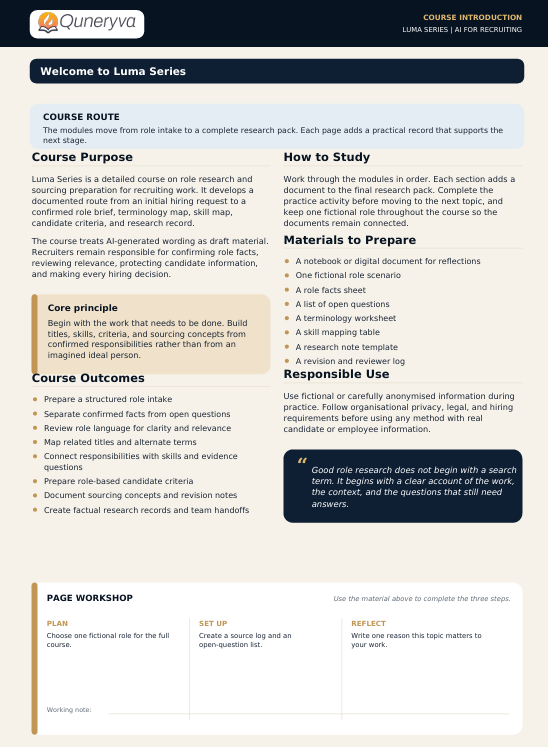
Luma Series introduces a practical method for turning hiring information into organised recruiting materials. Learners work through role intake, terminology review, sourcing preparation, candidate profile planning, and documentation tasks. Each module shows how to provide AI with relevant context while keeping human judgment responsible for final decisions. Guided exercises help learners compare drafts, remove unsupported statements, and connect each criterion to the role. The course is designed to develop a clear working process that can be adapted to different hiring situations.
3. What’s Inside
Luma Series begins with a role-intake module. Learners practise gathering information about responsibilities, team structure, required skills, working conditions, reporting lines, and hiring priorities. The activities show how incomplete notes can affect later recruiting materials.
The second module focuses on role language. Learners review sample descriptions for unclear wording, duplicated requirements, unnecessary jargon, and criteria that may not relate directly to the work. They then revise the material into a structured role summary that can guide later tasks.
A sourcing-preparation module introduces search concept planning without relying on any named service or program. Learners identify related job titles, alternative terminology, transferable skills, industry language, and role-specific keywords. The course also explains why search terms should be reviewed regularly rather than treated as fixed rules.
The candidate-profile module covers the difference between a role-based profile and an imagined ideal person. Learners are guided to focus on relevant experience, demonstrated skills, and stated role requirements. Exercises highlight how assumptions can narrow a search without a clear hiring reason.
The documentation module examines research notes, candidate comparison records, and handover summaries. Learners practise writing factual notes that separate observed information from interpretation. They also review examples of unclear or overly subjective wording.
A final applied activity combines the full process. Learners receive a sample hiring brief and create a role summary, sourcing outline, review checklist, and structured notes page.
Included materials feature:
- Role-intake question set
- Hiring-priority worksheet
- Role-language review checklist
- Search terminology planning pages
- Candidate-profile framework
- Transferable-skills mapping activity
- Research notes template
- Candidate comparison worksheet
- Bias-awareness review questions
- Annotated hiring examples
- Module knowledge checks
- Final applied recruiting scenario
4. Who Is This For?
Luma Series is intended for recruiters, sourcing specialists, hiring coordinators, talent partners, and team leads who work with role briefs and candidate research. It may also suit learners who have completed an introductory AI course and want to study a broader recruiting process.
No coding knowledge is required. The course is built around written exercises, realistic hiring situations, and structured review methods.
5. What You’ll Learn
- Gather relevant details during a role-intake discussion
- Organise hiring priorities into clear categories
- Review role descriptions for vague or duplicated wording
- Separate required criteria from optional preferences
- Create structured role summaries
- Identify related titles and alternative terminology
- Map transferable skills to stated responsibilities
- Prepare sourcing concepts for different role types
- Build role-based candidate profiles
- Avoid unsupported assumptions in candidate research
- Write factual and neutral recruiting notes
- Distinguish observations from personal interpretation
- Compare candidate information using consistent criteria
- Review AI-generated material for missing context
- Maintain human oversight throughout recruiting tasks
- Combine role research, sourcing preparation, and documentation in one workflow
6. Refund Terms
Luma Series includes a 30-day refund window beginning on the recorded purchase date. Requests must be submitted within that period and are reviewed according to the terms shown on the course page when the order is placed.
Eligibility may depend on the stated course-use and completion conditions. Approved refunds are returned through the original payment method, with timing determined by the payment provider.
Self-paced learning overview
- 📥 Digital file available after purchase
- ♾️ Long-term availability
- 🔐 Secure checkout
- 🗓️ Content updated in 2026
How are the Quneryva course tiers arranged?
How are the Quneryva course tiers arranged?
The tiers follow a gradual learning path, beginning with introductory materials and moving toward broader recruiting workflows. Each tier has its own topic range, learning depth, exercises, and downloadable resources. Learners may select a tier that matches their current role, prior knowledge, and study goals.
Do I need prior AI knowledge before enrolling?
Do I need prior AI knowledge before enrolling?
No prior technical background is required for the introductory tiers. The materials explain key ideas through clear language, recruiting examples, guided activities, and structured modules. Familiarity with basic recruiting tasks may help learners connect the topics with their daily work.
Can I choose another tier later?
Can I choose another tier later?
Yes. Learners may begin with one tier and select another Quneryva course when they are ready to explore additional topics. Each course listing explains its scope, included materials, and recommended learning stage.
Share