Quneryva
Halo Collection
Halo Collection
Couldn't load pickup availability
1. Problem Statement
Recruiting teams often gather large amounts of information without a consistent method for organising or reviewing it. Candidate activity, interview notes, communication records, and hiring stages may be recorded in separate formats. Numbers can also be presented without enough context, leading to unclear conclusions about what is happening within a hiring process. AI-generated summaries may overlook important details or describe patterns more strongly than the available information supports. Without a structured review method, teams may find it difficult to prepare clear and responsible recruiting reports.
2. Solution
Halo Collection introduces a structured approach to recruiting data review and written reporting. Learners examine how to define a reporting question before selecting information for analysis. The course shows how AI may assist with organising notes, summarising recurring themes, and preparing early report drafts. Each activity includes factual checks, context review, and careful interpretation before any conclusion is recorded. The course is intended to help learners communicate recruiting observations in a clear and measured way.
3. What’s Inside
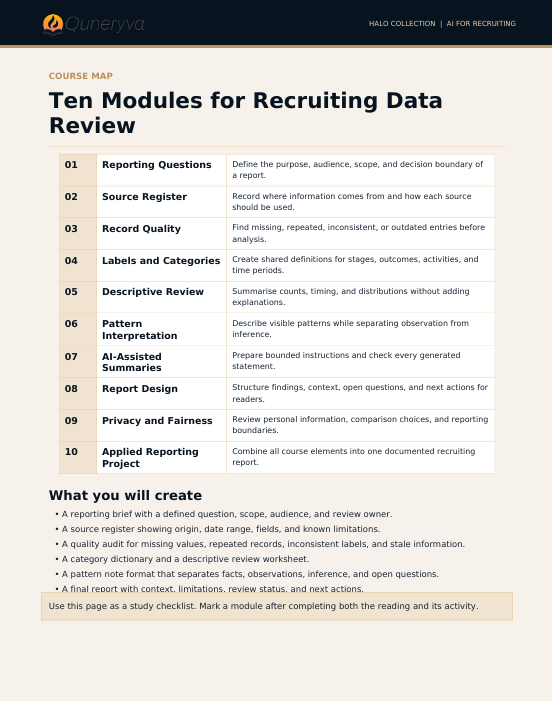
The opening module covers reporting questions. Learners practise turning broad requests into focused questions about hiring stages, candidate communication, interview activity, and workflow changes. This helps keep each review connected to a defined purpose.
The data-organisation module examines how recruiting information can be grouped by role, stage, date range, activity type, or team responsibility. Learners review sample records and identify missing labels, inconsistent categories, duplicated entries, and incomplete notes.
A pattern-review module introduces methods for identifying repeated themes without overstating their meaning. Learners compare activity counts, timing differences, candidate questions, interview observations, and process notes. The exercises highlight the difference between a visible pattern and a confirmed explanation.
The AI-assisted summary module shows how to prepare clear instructions for organising written information. Learners define the source material, reporting question, required format, and boundaries for interpretation. Sample outputs are reviewed for omitted details, unsupported conclusions, and wording that may require revision.
A reporting module covers concise summaries for hiring teams. Learners prepare short updates, stage reviews, issue summaries, and decision-support notes. Each report separates recorded facts, observations, open questions, and suggested areas for further review.
The final module focuses on responsible communication. Learners examine how charts, figures, and written summaries can influence interpretation. Activities encourage careful labeling, suitable comparison periods, and direct notes about missing or incomplete information.
Included materials feature:
- Reporting question planner
- Recruiting data category sheet
- Information quality checklist
- Pattern review worksheet
- Summary instruction template
- Factual review sequence
- Hiring stage report outline
- Open-question tracking page
- Observation and interpretation guide
- Sample recruiting records
- Annotated report examples
- Final reporting activity
4. Who Is This For?
Halo Collection is intended for recruiters, talent partners, hiring coordinators, team leads, and people who prepare recruiting updates or process reviews. It may suit learners who already work with structured recruiting materials and want to develop a clearer reporting method.
No coding knowledge is required. The course uses sample records, written exercises, reporting templates, and guided review activities.
5. What You’ll Learn
- Define focused questions for recruiting reports
- Organise information by role, stage, date, and activity
- Identify missing, duplicated, or inconsistent records
- Separate recorded facts from interpretation
- Review patterns without overstating their meaning
- Prepare clear instructions for AI-assisted summaries
- Check summaries for omitted or unsupported details
- Write concise hiring process updates
- Present observations with suitable context
- Record open questions for later review
- Compare activity across defined periods
- Explain limitations within a report
- Prepare structured notes for team discussions
- Review figures and written summaries for clarity
- Build a repeatable recruiting reporting method
6. Refund Terms
Halo Collection includes a 30-day refund window beginning on the recorded purchase date. Requests must be submitted within that period and are reviewed according to the terms displayed on the course page when the order is placed.
Eligibility may depend on the stated course-use conditions. Approved refunds are returned through the original payment method, with processing timing determined by the payment provider.
Self-paced learning overview
- 📥 Digital file available after purchase
- ♾️ Long-term availability
- 🔐 Secure checkout
- 🗓️ Content updated in 2026
How are the Quneryva course tiers arranged?
How are the Quneryva course tiers arranged?
The tiers follow a gradual learning path, beginning with introductory materials and moving toward broader recruiting workflows. Each tier has its own topic range, learning depth, exercises, and downloadable resources. Learners may select a tier that matches their current role, prior knowledge, and study goals.
Do I need prior AI knowledge before enrolling?
Do I need prior AI knowledge before enrolling?
No prior technical background is required for the introductory tiers. The materials explain key ideas through clear language, recruiting examples, guided activities, and structured modules. Familiarity with basic recruiting tasks may help learners connect the topics with their daily work.
Can I choose another tier later?
Can I choose another tier later?
Yes. Learners may begin with one tier and select another Quneryva course when they are ready to explore additional topics. Each course listing explains its scope, included materials, and recommended learning stage.
Share