Quneryva
Cipher Guide
Cipher Guide
Couldn't load pickup availability
1. Problem Statement
Recruiters may begin using AI with broad requests that produce inconsistent or incomplete drafts. Important details such as role level, hiring context, candidate audience, tone, and evaluation criteria are often left unstated. When these details are missing, generated material may require extensive revision or may not reflect the intended hiring task. Teams can also find it difficult to create a consistent method for reviewing different outputs. Without a clear framework, AI use may remain informal and difficult to repeat across recruiting workflows.
2. Solution
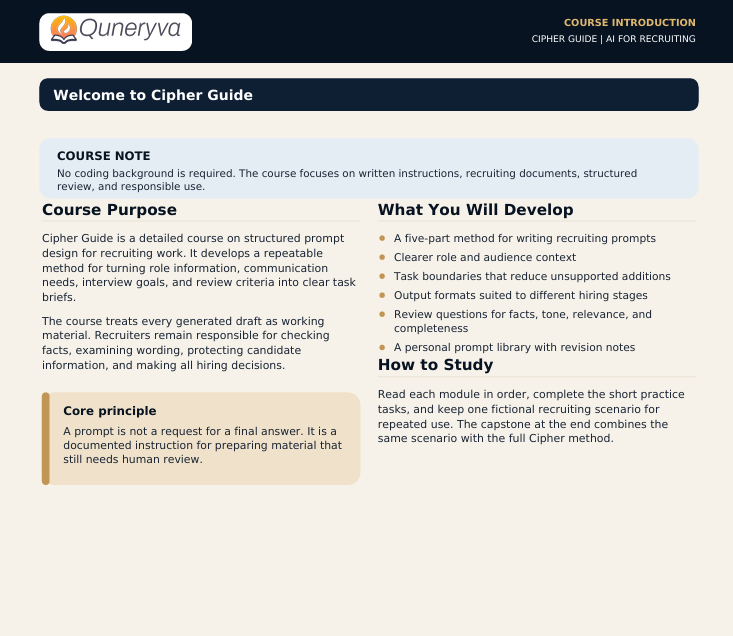
Cipher Guide introduces a structured approach to writing and reviewing prompts for recruiting activities. Learners explore how context, task definition, constraints, reference material, and output format work together. The course uses realistic hiring scenarios to show how one prompt can be revised through several stages. Each activity places human review, factual checking, and responsible judgment at the centre of the process. The course is designed to help learners create a repeatable working method for common recruiting tasks.
3. What’s Inside
Cipher Guide contains a sequence of detailed modules focused on prompt structure and recruiting communication. The first module introduces the five-part Cipher method: context, intention, parameters, format, and review. Learners examine how each part changes the direction and usefulness of a written request.
The next module focuses on role research. Learners practise organising information about responsibilities, required skills, seniority, team structure, and hiring priorities before preparing a prompt. Sample exercises show how incomplete context can lead to vague drafts and how added detail can make the material more relevant.
A communication module explores candidate-facing writing. It covers initial outreach drafts, interview preparation notes, follow-up messages, and neutral rejection wording. Learners review tone, clarity, respectful language, and unsupported statements. The course does not present generated text as ready to send; every example includes a review stage.
Another module covers screening preparation. Learners create structured question sets based on stated role requirements while avoiding assumptions about a candidate’s background. Activities include identifying duplicated questions, separating required criteria from preferences, and checking whether each question relates directly to the role.
The final module introduces prompt comparison. Learners use a simple scoring framework to assess relevance, clarity, factual alignment, tone, and completeness. This helps them document why one draft may be more suitable than another.
Included materials feature:
- The five-part Cipher prompt worksheet
- Role-context planning pages
- Candidate message review checklist
- Interview-question planning template
- Prompt comparison scorecard
- Responsible-use review questions
- Sample prompts with annotated revisions
- Scenario-based practice activities
- Personal workflow notes
- End-of-module knowledge checks
4. Who Is This For?
Cipher Guide is intended for recruiters, hiring coordinators, talent partners, team leads, and learners who understand basic AI concepts and want a more structured working method. It may suit people who regularly prepare role descriptions, candidate messages, interview notes, or hiring documentation.
The course does not require coding knowledge. It is suitable for learners who prefer detailed examples, guided exercises, and practical recruiting scenarios.
5. What You’ll Learn
- Build prompts using a consistent five-part structure
- Define the purpose of a recruiting task before drafting
- Add relevant role, audience, and tone context
- Set clear boundaries for generated material
- Request useful output formats for different workflows
- Review candidate-facing language for clarity and respect
- Prepare interview-question outlines linked to role criteria
- Separate required qualifications from preferred qualities
- Identify vague, duplicated, or unrelated questions
- Compare multiple drafts using defined criteria
- Record revisions in a repeatable workflow
- Check generated material for unsupported statements
- Recognise where human judgment remains necessary
- Create personal prompt templates for recurring recruiting tasks
6. Refund Terms
Cipher Guide includes a 30-day refund window from the recorded purchase date. Requests must be submitted within that period and are reviewed under the terms displayed on the course page at the time of purchase.
Refund eligibility may depend on the stated usage and completion conditions. Approved requests are returned through the original payment method, subject to the processing times of the payment provider.
Self-paced learning overview
- 📥 Digital file available after purchase
- ♾️ Long-term availability
- 🔐 Secure checkout
- 🗓️ Content updated in 2026
How are the Quneryva course tiers arranged?
How are the Quneryva course tiers arranged?
The tiers follow a gradual learning path, beginning with introductory materials and moving toward broader recruiting workflows. Each tier has its own topic range, learning depth, exercises, and downloadable resources. Learners may select a tier that matches their current role, prior knowledge, and study goals.
Do I need prior AI knowledge before enrolling?
Do I need prior AI knowledge before enrolling?
No prior technical background is required for the introductory tiers. The materials explain key ideas through clear language, recruiting examples, guided activities, and structured modules. Familiarity with basic recruiting tasks may help learners connect the topics with their daily work.
Can I choose another tier later?
Can I choose another tier later?
Yes. Learners may begin with one tier and select another Quneryva course when they are ready to explore additional topics. Each course listing explains its scope, included materials, and recommended learning stage.
Share